

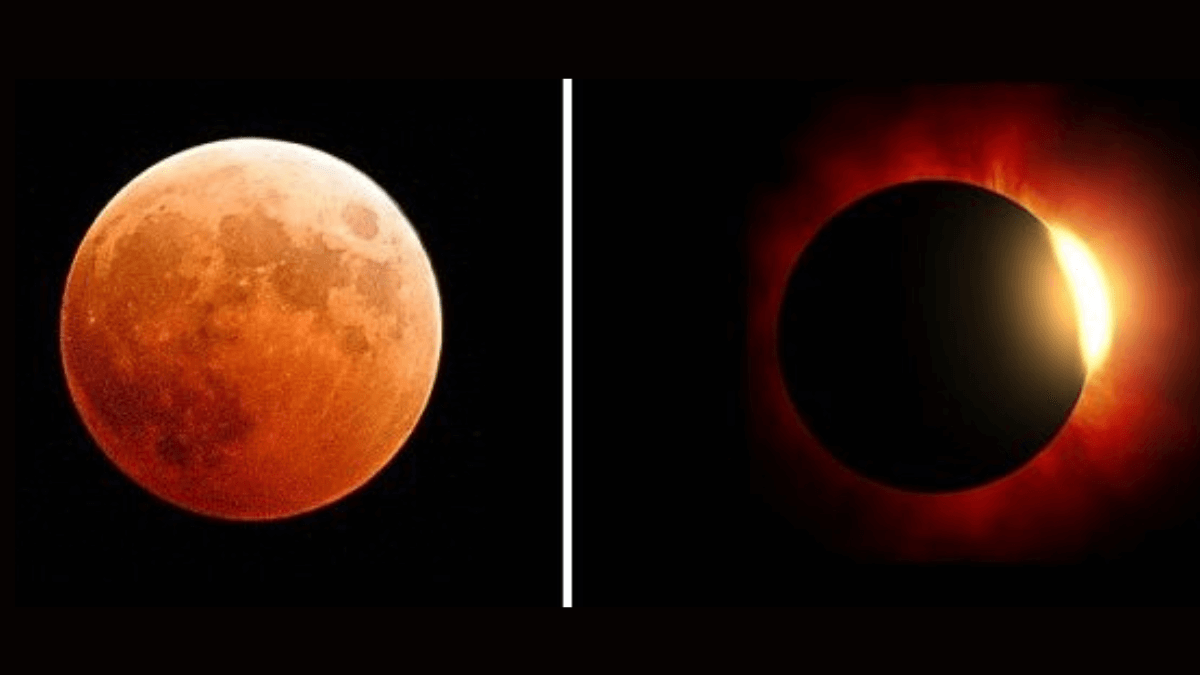
The sky often surprises us with breathtaking events, and eclipses are among the most fascinating. Both solar eclipses and lunar eclipses happen because the Sun, Earth, and Moon align in special ways. Even though both involve the same three celestial bodies, they look very different and are experienced in unique ways. Let’s explore how they differ, how they are similar, and why they are so important.
What is a Solar Eclipse?
A solar eclipse takes place when the Moon passes between the Earth and the Sun, blocking sunlight from reaching Earth. Depending on the alignment, this can be:
-
Total solar eclipse – the Sun is completely covered.
-
Partial solar eclipse – only part of the Sun is blocked.
-
Annular solar eclipse – the Moon covers the center, leaving a glowing ring of sunlight.
Solar eclipses are short, often lasting just a few minutes, and can only be seen from specific regions on Earth. Because of the Sun’s brightness, people need special solar glasses to view them safely.
What is a Lunar Eclipse?
A lunar eclipse happens when the Earth comes between the Sun and the Moon, casting its shadow on the Moon. Types of lunar eclipses include:
-
Total lunar eclipse – the Moon is fully in Earth’s shadow and turns a reddish color (often called a blood moon).
-
Partial lunar eclipse – only part of the Moon is darkened.
-
Penumbral lunar eclipse – a faint shadow makes the Moon slightly dimmer.
Lunar eclipses last longer than solar eclipses, sometimes for several hours. They are also visible from anywhere on Earth where it is nighttime, and they can be watched safely with the naked eye.
Key Difference Between Solar Eclipse and Lunar Eclipse
A solar eclipse happens when the Moon blocks the Sun’s light and casts a shadow on Earth, while a lunar eclipse occurs when Earth blocks sunlight from reaching the Moon. Though both involve the Sun, Earth, and Moon, they differ in visibility, duration, and appearance.
Here is the difference between Solar Eclipse and Lunar Eclipse:
Basis of Difference
|
Solar Eclipse
|
Lunar Eclipse
|
Cause
|
Moon blocks sunlight
|
Earth blocks sunlight from reaching Moon
|
Where visible?
|
Only in certain parts of Earth
|
Anywhere it is night
|
Types
|
Total, Partial, Annular
|
Total, Partial, Penumbral
|
Duration
|
Few minutes
|
Up to a few hours
|
Safety
|
Needs eye protection
|
Safe to view directly
|
Effect
|
Daytime darkness, cooler temperature
|
Moon changes color, often turns reddish
|
SOURCE-CURRENTAFFAIRSADDA

©kamaleshforeducation.in(2023)
Related
