


Governor Verdict: The 11 questions Supreme Court answered and the 3 it didn’t
It was the 16th reference that a President had made to the Supreme Court under Article 143 of the Constitution of India.
The Supreme Court on Thursday answered a reference made by the President Droupadi Murmu on interpretation of powers of the Governor under Articles 200 and 201 of the Constitution.
It was the 16th reference made by a President to the Supreme Court under Article 143 of the Constitution of India in its 75-year history. Except for one, the top court has answered all the references in part or full.
The latest reference arose after a two-judge bench’s decision in The State of Tamil Nadu v The Governor of Tamil Nadu and Anr.
In the April 2025 ruling, a bench of Justices JB Pardiwala and R Mahadevan ruled that there was no scope of inaction under Article 200 and fixed timelines for acting on the bills presented to him for assent.
President Murmu then raised 14 questions before the top court under the advisory jurisdiction provided exclusively to her by the Constitution.
Today, a Chief Justice of India BR Gavai and Justices Surya Kant, Vikram Nath, PS Narasimha and Atul S Chandurkar answered 11 of them and returned the rest without any response.
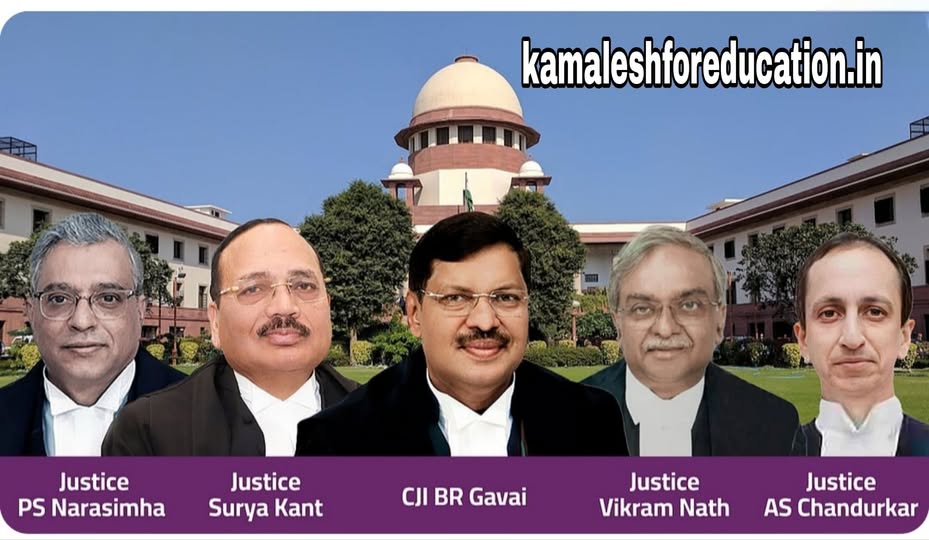
CJI BR Gavai and Justices Surya Kant, Vikram Nath, PS Narasimha and Atul S Chandurkar
Below are the questions and a summary of the answers given by the Supreme Court in an 111-page opinion:
1. What are the constitutional options before a Governor when a Bill is presented to him under Article 200 of the Constitution of India?
The Constitution Bench today opined that the Governor does not have the power to simply withhold a bill.
It said that the Governor has three options:
a. to assent.
b. to reserve the bill for the consideration of the President.
c. to withhold assent and return the bill to legislature with comments.
What happens when the legislature passes the reconsidered bill without or without amendment? The Court today opined that the Governor cannot withhold assent even at this stage but still gets the option to reserve it for the President’s consideration.
“Therefore, when the Bill is returned to the Governor, he is still left with two options – either to grant his assent, or to refer it to the President for his consideration. This power to reserve a Bill for the President’s consideration, is irrespective of whether the Bill is returned by the Legislature in its amended or unamended form,” it said.
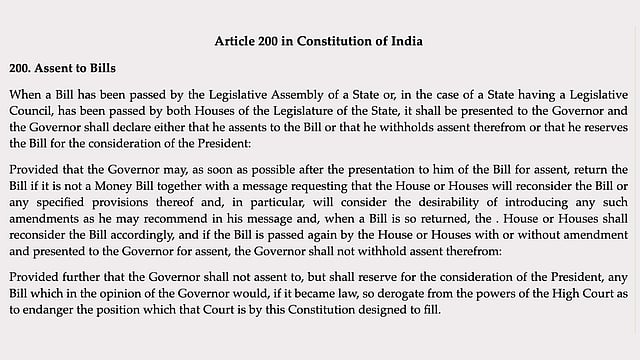
Article 200
Importantly, in context of option (c), the Court noted that though phrase “shall not withhold assent therefrom” is employed in the first proviso to Article 200, it is absent from a similarly worded proviso to Article 201.
Article 201 deals with the options the President has upon reservation under Article 200. Can the President withhold a Bill?
Since the said question was not raised in the reference, the Supreme Court said it need not say anything on that.
“Upon reservation under Article 200, the President is empowered to exercise his options under Article 201, and the proviso also provides for an option to return the Bill to the House with a message. What is important is that the words “shall not withhold therefrom” which is present in the first proviso to Article 200 is conspicuously absent from the proviso to Article 201. Since the Presidential reference has not sought our opinion as regards the options under Article 201, we say no further.”
2. Is the Governor bound by the aid and advice tendered by the Council of Ministers while exercising all the options available with him when a Bill is presented before him under Article 200 of the Constitution of India?
The Constitution Bench said that the Governor “ordinarily” exercises his functions in accordance with the aid and advice tendered by the Council of Ministers. However, it added that the Constitution itself provides that the Governor may discharge certain functions upon his discretion, and without being bound by the aid and advice tendered by the Council of Ministers.
In context of Article 200, the Court opined that inclusion of the phrase “in the opinion of the Governor” in the second proviso to Article 200 is a definitive expression of the fact that Governor does enjoy discretion in discharging his functions under Article 200.
“Having already held that the Governor does not have powers simpliciter to withhold, we find that the Governor has discretion in the context of referring a Bill for the consideration of the President, or for returning the Bill to the Legislature with his comments,” the Court said.
However, it also opined that this interpretation does not confer any unfettered powers on the Governor.
“In fact, it does not in any way deviate from the concept of a responsible constitutional government,” the Court said.
3. Is the exercise of constitutional discretion by the Governor under Article 200 of the Constitution of India justiciable?
The Court answered that the constitutional choice made by the Governor is not justiciable and a merit review is unavailable in judicial proceedings.
4. Is Article 361 of the Constitution of India an absolute bar to the judicial review in relation to the actions of a Governor under Article 200 of the Constitution of India?
Even as it said that the Courts cannot look into the merits of a Governor’s decision, the bench clarified that they can always take cognizance of inaction and for that limited purpose, a direction can be issued asking the Governor to exercise his constitutional choice within a reasonable period of time.
“This limited judicial review, cannot be overcome on the pretext of Article 361, which offers personal immunity to the Governor. The constitutional office of the Governor is definitely subject to the jurisdiction of the court, to prevent prolonged and evasive constitutional inaction,” it added.
5. In the absence of a constitutionally prescribed time limit, and the manner of exercise of powers by the Governor, can timelines be imposed and the manner of exercise be prescribed through judicial orders for the exercise of all powers under Article 200 of the Constitution of India by the Governor?
The Constitution Bench today said that the imposition of timelines on the Governor under Article 200 in Tamil Nadu case was erroneous.
It reasoned that the text of Articles 200 and 201 has been framed in such a manner, so as to provide “a sense of elasticity, for constitutional authorities to perform their functions, keeping in mind the diverse contexts and situations, and by consequence the need for balancing that might arise in the process of lawmaking in a federal, and democratic country like ours”.
Thus, as a natural corollary of this reasoning, the Court said there cannot be a concept of ‘deemed consent’ in absence of any prescribed timelines under Articles 200 and 201.
There cannot be a concept of ‘deemed consent’ in absence of any prescribed timelines under Articles 200 and 201.
Supreme Court
