



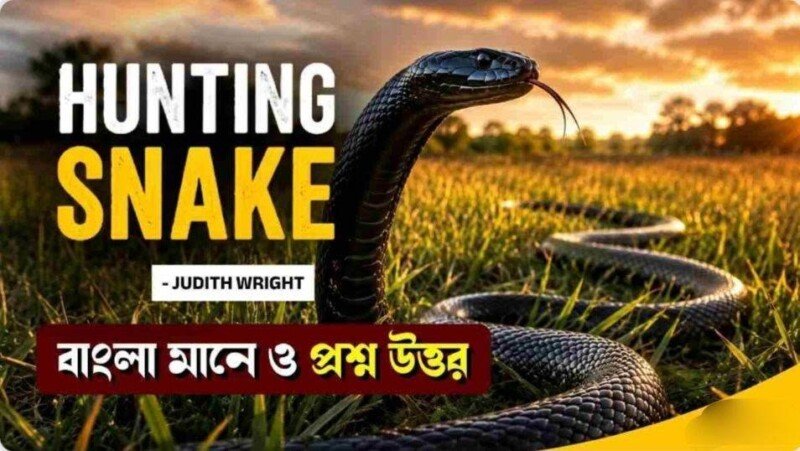
Hunting Snake
WBBSE Class 9 English Lesson 12
Question Answer and Summary
Published on:
আজকের এই পোস্টে আমরা পশ্চিমবঙ্গ মধ্যশিক্ষা পর্ষদের (WBBSE) নবম শ্রেণির ইংরেজি পাঠ্যবইয়ের Lesson 12, Judith Wright লেখা ‘Hunting Snake’ কবিতাটির সম্পূর্ণ প্রশ্ন-উত্তর, সারাংশ (Summary) এবং লাইন-ভিত্তিক বাংলা অর্থ নিয়ে আলোচনা করব। এই কবিতাটিতে এক রৌদ্রোজ্জ্বল দিনে কবির সামনে দিয়ে হঠাৎ একটি শিকারি কালো সাপের চলে যাওয়ার দৃশ্য, সাপের রাজকীয় ও ভয়ংকর সৌন্দর্য এবং সেই মুহূর্তে কবির ও তাঁর সঙ্গীর মনে তৈরি হওয়া চরম বিস্ময় ও ভীতির এক অনবদ্য চিত্র খুব সুন্দরভাবে ফুটিয়ে তোলা হয়েছে।
বিষয় |
বিবরণ |
|---|---|
Lesson Name |
Hunting Snake |
Author |
Judith Wright |
Source |
WBBSE Class 9 English Textbook (Bliss) |
Main Characters |
The poet, her companion(s), and the black snake |
◆ বিষয়বস্তু ◆
1 Hunting Snake By Judith Wright (Class 9 English Lesson 12)
1.1 ‘Hunting Snake’ Class 9 Summary – সারসংক্ষেপ
1.2 Hunting Snake By Judith Wright Bengali Meaning – সহজ বাংলা ভাষায় অর্থ
1.3 ‘Hunting Snake’ Class 9 Unit-wise Textual Question Answers | Class 9 English Lesson 12
1.4 Hunting Snake By Judith Wright Textual Grammar Solution
1.5 ‘Hunting Snake’ Class 9 One Liner Question Answer (Extra)
1.6 Hunting Snake By Judith Wright Important MCQ | Class 9 Hunting Snake Question Answer
Hunting Snake By Judith Wright
(Class 9 English Lesson 12)
About the Author:
Judith Arundell Wright (1915-2000) was an Australian poet and environmentalist. Among several collections of her poetry, the most notable are The Moving Image, Woman to Man, The Gateway and many more.
বাংলা অনুবাদ:
জুডিথ অরুন্ডেল রাইট (১৯১৫-২০০০) ছিলেন একজন অস্ট্রেলিয়ান কবি এবং পরিবেশবাদী। তাঁর রচিত বেশ কয়েকটি কবিতা সংকলনের মধ্যে উল্লেখযোগ্য হলো দ্য মুভিং ইমেজ, ওম্যান টু ম্যান, দ্য গেটওয়ে এবং আরও অনেক কিছু।
‘Hunting Snake’ Class 9 Summary – সারসংক্ষেপ
English Summary:
The poem describes the poet’s experience of watching a black snake as it makes its way across an area of grassland. The poet and her companions were walking under the gentle autumn sky when they saw the great black snake reeling by. The poet looks on, fascinated, as the snake hunts for its food with a flickering tongue and fierce intent, and finally disappears into the grass. After the snake leaves, they take a deep breath and continue their walk.
বাংলা অনুবাদ:
এই কবিতায় কবি একটি কালো সাপকে ঘাসজমির উপর দিয়ে যেতে দেখার অভিজ্ঞতার বর্ণনা দিয়েছেন। কবি এবং তাঁর সঙ্গীরা শরতের স্নিগ্ধ আকাশের নিচে হাঁটছিলেন, এমন সময় তারা একটি বিশাল কালো সাপকে এঁকেবেঁকে যেতে দেখেন। কবি মুগ্ধ হয়ে দেখেন কীভাবে সাপটি লিকলিকে জিভ নেড়ে এবং হিংস্র মনোযোগের সাথে তার খাবার খুঁজছে এবং শেষ পর্যন্ত ঘাসের মধ্যে অদৃশ্য হয়ে যায়। সাপটি চলে যাওয়ার পর, তারা স্বস্তির নিশ্বাস নেন এবং সামনের দিকে এগিয়ে যান।
Hunting Snake By Judith Wright Bengali Meaning
সহজ বাংলা ভাষায় অর্থ
Stanza 1 (প্রথম স্তবক)
Sun-warmed in the late season’s grace
under the autumn’s gentlest sky
we walked and froze half-through a pace.
The great black snake went reeling by.
বাংলা অনুবাদ:
শেষ ঋতুর বা হেমন্তের স্নিগ্ধতায় রৌদ্রে উষ্ণ হয়ে
শরতের সবচেয়ে শান্ত আকাশের নিচে
আমরা হাঁটছিলাম এবং অর্ধেক পা ফেলেই স্থির হয়ে দাঁড়ালাম।
বিশাল কালো সাপটি এঁকেবেঁকে চলে গেল।
Stanza 2 (দ্বিতীয় স্তবক)
Head down, tongue flickering on the trail
He quested through the parting grass.
Sun glazed his curves of diamond scale
And we lost breath to see him pass.
বাংলা অনুবাদ:
মাথা নিচু করে, চলার পথে তার জিভ লিকলিক করছিল
সে ফাঁকা হয়ে যাওয়া ঘাসের মধ্যে দিয়ে তার শিকার খুঁজছিল।
সূর্যের আলো তার হীরার মতো আঁশের বাঁকগুলোকে চকচকে করে তুলেছিল
আর তাকে যেতে দেখে উত্তেজনায় ও ভয়ে আমাদের নিশ্বাস বন্ধ হয়ে আসছিল।
Stanza 3 (তৃতীয় স্তবক)
What track he followed, what small food
Fled living from his fierce intent,
we scarcely thought; still as we stood
our eyes went with him as he went.
বাংলা অনুবাদ:
সে কোন পথ ধরে এগিয়ে যাচ্ছিল, বা কোন ছোটখাটো খাবার
তার হিংস্র লক্ষ্যের হাত থেকে প্রাণ নিয়ে পালিয়েছিল,
সে কথা আমরা প্রায় ভাবছিলামই না; আমরা স্থির হয়ে দাঁড়িয়েছিলাম
সে যেদিকে এগিয়ে যাচ্ছিল আমাদের চোখও ঠিক সেদিকেই তাকে অনুসরণ করছিল।
Stanza 4 (চতুর্থ স্তবক)
Cold, dark and splendid he was gone
Into the grass that hid his prey.
We took a deeper breath of day,
Looked at each other, and went on.
বাংলা অনুবাদ:
শীতল, অন্ধকার এবং চমৎকার সাপটি অবশেষে চলে গেল
সেই ঘাসের মধ্যে যা তার শিকারকে লুকিয়ে রেখেছিল।
সাপটি চলে যাওয়ার পর আমরা দিনের এক গভীর ও স্বস্তির নিশ্বাস নিলাম,
একে অপরের দিকে তাকালাম, এবং নিজেদের পথে এগিয়ে গেলাম।
‘Hunting Snake’
Class 9 Unit-wise Textual Question Answers
Class 9 English Lesson 12
Exercise 1:
Choose the correct alternative to complete the following sentences:
(1) The poet was sun-warmed under the gentlest sky of— (কবি কোন ঋতুর সবচেয়ে শান্ত আকাশের নিচে রোদ পোহাচ্ছিলেন—)
(i) summer
(ii) winter
(iii) autumn
(iv) spring
Answer: (iii) autumn
(2) The colour of the snake was— (সাপটির রঙ ছিল—)
(i) black
(ii) grey
(iii) green
(iv) yellow
Answer: (i) black
(3) The tongue of the snake was— (সাপটির জিভ ছিল—)
(i) still
(ii) flickering
(iii) dangling
(iv) hanging
Answer: (ii) flickering
(4) The shape of the snake’s scale was like— (সাপের আঁশের আকার ছিল—)
(i) star
(ii) kite
(iii) diamond
(iv) pyramid
Answer: (iii) diamond
(5) According to the poet, the intent of the snake was— (কবির মতে, সাপের উদ্দেশ্য ছিল—)
(i) malicious
(ii) greedy
(iii) timid
(iv) fierce
Answer: (iv) fierce
(6) The snake finally disappeared into the— (সাপটি অবশেষে কোথায় অদৃশ্য হয়ে গেল—)
(i) sand
(ii) grass
(iii) rock
(iv) stream
Answer: (ii) grass
Exercise 2:
Answer the following questions within twenty-five words
(i) How did the snake appear as it was moving through the grass? (সাপটি যখন ঘাসের মধ্যে দিয়ে যাচ্ছিল তখন তাকে কেমন দেখাচ্ছিল?)
Answer: As the snake moved through the parting grass, it appeared great and black with its head down and tongue flickering on the trail. The sun glazed its diamond-like scales.
(উত্তর: সাপটি যখন ফাঁকা ঘাসের মধ্যে দিয়ে যাচ্ছিল, তখন তাকে বিশাল এবং কালো দেখাচ্ছিল, তার মাথা নিচু ছিল এবং পথের ওপর জিভ লিকলিক করছিল। সূর্যের আলো তার হীরক-সদৃশ আঁশগুলোকে চকচকে করে তুলেছিল।)
(ii) What did the poet and her companions do when the snake was gone? (সাপটি চলে যাওয়ার পর কবি এবং তার সঙ্গীরা কী করেছিল?)
Answer: When the cold, dark, and splendid snake disappeared into the grass, the poet and her companions took a deeper breath of day, looked at each other, and went on their way.
(উত্তর: যখন শীতল, অন্ধকার এবং চমৎকার সাপটি ঘাসের মধ্যে অদৃশ্য হয়ে গেল, কবি এবং তাঁর সঙ্গীরা স্বস্তির গভীর নিশ্বাস নিলেন, একে অপরের দিকে তাকালেন এবং তাদের পথে এগিয়ে গেলেন।)
Hunting Snake By Judith Wright
Textual Grammar Solution
Exercise 3 –
Rewrite the following sentences as directed:
(a) How happy we are here! (change into an assertive sentence)
(আমরা এখানে কতই না খুশি!)
Answer: We are very happy here.
(উত্তর: আমরা এখানে খুব খুশি।)
(b) Everybody knows the name of Tagore. (change into an interrogative sentence)
(সবাই ঠাকুরের নাম জানে।)
Answer: Who does not know the name of Tagore?
(উত্তর: ঠাকুরের নাম কে না জানে?)
(c) The painting is very beautiful. (change into an exclamatory sentence)
(পেইন্টিংটি খুব সুন্দর।)
Answer: How beautiful the painting is!
(উত্তর: পেইন্টিংটি কতই না সুন্দর!)
(d) Can we ever forget our childhood days? (change into an assertive sentence)
(আমরা কি কখনো আমাদের ছোটবেলার দিনগুলো ভুলতে পারি?)
Answer: We can never forget our childhood days.
(উত্তর: আমরা কখনোই আমাদের ছোটবেলার দিনগুলো ভুলতে পারি না।)
Exercise 4
Rewrite the following sentences as directed:
(a) We are proud of our heritage. (use the noun form of ‘proud’)
(আমরা আমাদের ঐতিহ্য নিয়ে গর্বিত।)
Answer: We take pride in our heritage.
(উত্তর: আমরা আমাদের ঐতিহ্য নিয়ে গর্ববোধ করি।)
(b) We should have sympathy for the poor. (use the adjective form of ‘sympathy’)
(গরিবদের প্রতি আমাদের সহানুভূতি থাকা উচিত।)
Answer: We should be sympathetic to the poor.
(উত্তর: গরিবদের প্রতি আমাদের সহানুভূতিশীল হওয়া উচিত।)
(c) His success was due to his labour. (use the verb form of ‘labour’)
(তার সাফল্য তার শ্রমের কারণে হয়েছিল।)
Answer: He laboured hard to achieve success.
(উত্তর: সে সাফল্য অর্জনের জন্য কঠোর পরিশ্রম করেছিল।)
(d) The song of the nightingale is very sweet. (use the adverb form of ‘sweet’)
(নাইটিংগেলের গান খুব মিষ্টি।)
Answer: The nightingale sings very sweetly.
(উত্তর: নাইটিংগেল খুব মিষ্টিভাবে গায়।)
Exercise 5:
Write a newspaper report on a boat capsize.
(নৌকাডুবির উপর একটি খবরের কাগজের প্রতিবেদন লেখো।)
Answer: Tragic Boat Capsize Leaves Many Missing By a Staff Reporter Kolkata, October 15: A tragic boat capsize occurred on the river Hooghly yesterday evening. The overloaded boat was carrying around fifty passengers. The disaster happened when a sudden storm hit, causing the boat to lose balance and overturn. While local fishermen immediately launched rescue operations and managed to save around thirty people, five casualties have been reported, and fifteen are still missing. The Government has deployed disaster management teams and announced a compensation of two lakh rupees for the families of the deceased.
(উত্তর: একটি সংক্ষিপ্ত প্রতিবেদন যেখানে নৌকাডুবির স্থান, তারিখ, কারণ, হতাহত এবং সরকারের পদক্ষেপ তুলে ধরা হয়েছে।)
Exercise 6:
Write a summary of the passage.
(অনুচ্ছেদটির একটি সারসংক্ষেপ লেখো।)
Answer: Importance of Teaching Values to Children Values form the foundation of a child’s beliefs and societal functioning. Essential virtues like honesty, kindness, humility, and courage must be taught to children to build a respectful and stable society. Unlike animals born with survival instincts, human babies are dependent and possess complex emotional needs. Teaching them values early is crucial, as it helps them control selfish desires and act responsibly within the community.
(উত্তর: শিশুদের মূল্যবোধ শেখানোর প্রয়োজনীয়তা নিয়ে অনুচ্ছেদটির মূল কথা।)
‘Hunting Snake’
Class 9 One Liner Question Answer (Extra)
★ The season described in the poem: Late autumn (হেমন্তের শেষ দিক)
★ The sky is described as: Gentlest (সবচেয়ে স্নিগ্ধ)
★ The poet and companions were warmed by: The sun (সূর্য)
★ The walkers stopped suddenly or: Froze (স্থির হয়ে গেল)
★ The snake mentioned in the poem was: Great and black (বিশাল এবং কালো)
★ The snake was moving: Reeling by (এঁকেবেঁকে চলছিল)
★ The position of the snake’s head was: Head down (মাথা নিচু)
★ The snake’s tongue was doing what on the trail: Flickering (লিকলিক করছিল)
★ The path the snake was following is called: Trail (পথ)
★ The snake was searching or: Quested (খুঁজছিল)
★ The snake moved through the: Parting grass (ফাঁকা হয়ে যাওয়া ঘাস)
★ The snake’s scales looked like: Diamond (হীরা)
★ The sunlight made the snake’s curves: Glazed (চকচকে)
★ The onlookers lost their: Breath (নিশ্বাস)
★ The observers lost their breath to see the snake: Pass (যেতে)
★ The snake was looking for: Small food (ছোটখাটো খাবার)
★ The prey fled because of the snake’s: Fierce intent (হিংস্র উদ্দেশ্য)
★ The observers scarcely: Thought (ভেবেছিল)
★ As the snake went, the onlookers stood: Still (স্থির)
★ The onlookers’ eyes followed the: Snake (সাপকে)
★ The snake is described in the last stanza as: Cold, dark and splendid (শীতল, অন্ধকার এবং চমৎকার)
★ The snake finally disappeared into the: Grass (ঘাস)
★ The grass hid the snake’s: Prey (শিকার)
★ After the snake disappeared, they took a: Deeper breath of day (দিনের এক গভীর নিশ্বাস)
★ After taking a deep breath, they looked at: Each other (একে অপরের দিকে)
★ After looking at each other, the walkers: Went on (এগিয়ে গেল)
★ The author of this poem is: Judith Wright (জুডিথ রাইট)
★ The poet Judith Wright belonged to: Australia (অস্ট্রেলিয়া)
★ The word ‘intent’ means: Aim (উদ্দেশ্য)
★ The word ‘quested’ means: Searched (খুঁজেছিল)
★ Sudden forward and backward movement is called: Flickering (লিকলিক করা)
★ Moving in curves is called: Reeling (এঁকেবেঁকে চলা)
Hunting Snake By Judith Wright Important MCQ
Class 9 Hunting Snake Question Answer
(1) The sky during the late season was— (শেষ ঋতুতে আকাশ ছিল—)
(i) cloudy
(ii) gentlest
(iii) harsh
Answer: (ii) gentlest
(2) The walkers froze— (হাঁটতে থাকা মানুষেরা স্থির হয়ে গিয়েছিল—)
(i) completely
(ii) half-through a pace
(iii) at the end of the road
Answer: (ii) half-through a pace
(3) The snake went by— (সাপটি পাশ দিয়ে গেল—)
(i) jumping
(ii) running
(iii) reeling
Answer: (iii) reeling
(4) The snake kept its head— (সাপটি তার মাথা রেখেছিল—)
(i) down
(ii) up
(iii) hidden
Answer: (i) down
(5) The snake’s tongue was flickering on the— (সাপের জিভ লিকলিক করছিল—)
(i) branch
(ii) trail
(iii) stone
Answer: (ii) trail
(6) The snake quested through the— (সাপটি খুঁজছিল—)
(i) parting grass
(ii) dense forest
(iii) dry leaves
Answer: (i) parting grass
(7) The scales of the snake were compared to— (সাপের আঁশগুলোকে তুলনা করা হয়েছে—)
(i) gold
(ii) diamond
(iii) silver
Answer: (ii) diamond
(8) What glazed the snake’s curves? (কী সাপের বাঁকগুলোকে চকচকে করেছিল?)
(i) the moon
(ii) the sun
(iii) the water
Answer: (ii) the sun
(9) The observers lost their breath to see him— (দর্শকরা তাকে দেখে নিশ্বাস বন্ধ করে ফেলেছিল—)
(i) pass
(ii) bite
(iii) sleep
Answer: (i) pass
(10) The food fled from the snake’s— (খাবার সাপের কাছ থেকে পালিয়েছিল তার—)
(i) kind nature
(ii) fierce intent
(iii) loud noise
Answer: (ii) fierce intent
আজকের পোস্টে নবম শ্রেণী ইংরেজি বিষয় এর Judith Wright লেখা কবিতা ‘Hunting Snake’ এর লাইন ধরে বাংলা অর্থ, প্রত্যেক Unit এর সমাধান এবং Unit ভিত্তিক বাছাই করা অতিরিক্ত কিছু One Liner প্রশ্ন উত্তর শেয়ার করা হল। যেগুলি পরীক্ষার প্রস্তুতি নিতে সহায়তা করবে।
SOURCE-EDT

©kamaleshforeducation.in(2023)